

Find out below what Google Bard is and how to make the most of it to succeed in real estate transactions this 2023.

2023 has been the scene of important technological advances and launches that open up a new range of possibilities for the world's industries.In the specific case of real estate, we previously talked about how to use ChatGPT and how to use ChatGPT and Midjourney to drive property sales, as well as how to use ChatGPT and Midjourney to drive property sales.and, in addition, from nolab we have presented the first property appraiser specializing in the luxury sector in Mexico. In this context, today we will talk about the new tool developed by the giant of internet searches and queries, Google. Discover below what Google Bard is and how to use it to improve your real estate transactions.
What is it and why does Google Bard raise a new world of possibilities for marketing properties around the world? Google Bard is a large linguistic model chatbot developed by the Google AI division. It is based on the LaMDA (Language Model for Dialogue Applications) linguistic model, which was trained on a massive dataset of text and code. In principle, Bard can generate text, translate languages, write different types of creative content and answer your questions in an informative way, and in upcoming updates it will be able to develop and manage digital marketing campaigns through Google's ad platforms automatically.
Google Bard uses a process called machine learning; a type of artificial intelligence that allows computers to analyze and learn from data. One of the main differences between Bard and ChatGPT is that Bard, being a native Google tool, connects directly to the Internet on a permanent basis to provide updated answers. For the time being, this is not the case with ChatGPT, since this model uses its own database, which is updated with data up to 2021.
To start using the tool all you have to do is go to its official site and start making requests through prompts. At the moment Bard works only with English queries, but it is expected that it will soon be able to interact in many more languages.

More and more technology companies are integrating specialized functions with AI for native content development. Although the offer is wide, there are still few tools that really offer a 360° experience that fits today's real needs. Google Bard currently promises 4 key capabilities:
Although the tool is already available, Google Bard is currently in an "experimental" stage. As of today, it is not yet able to deliver all the benefits that the platform promises. However, user queries constantly strengthen the tool to provide better solutions.
Bard is currently able to generate better content for the real estate sector as follows:
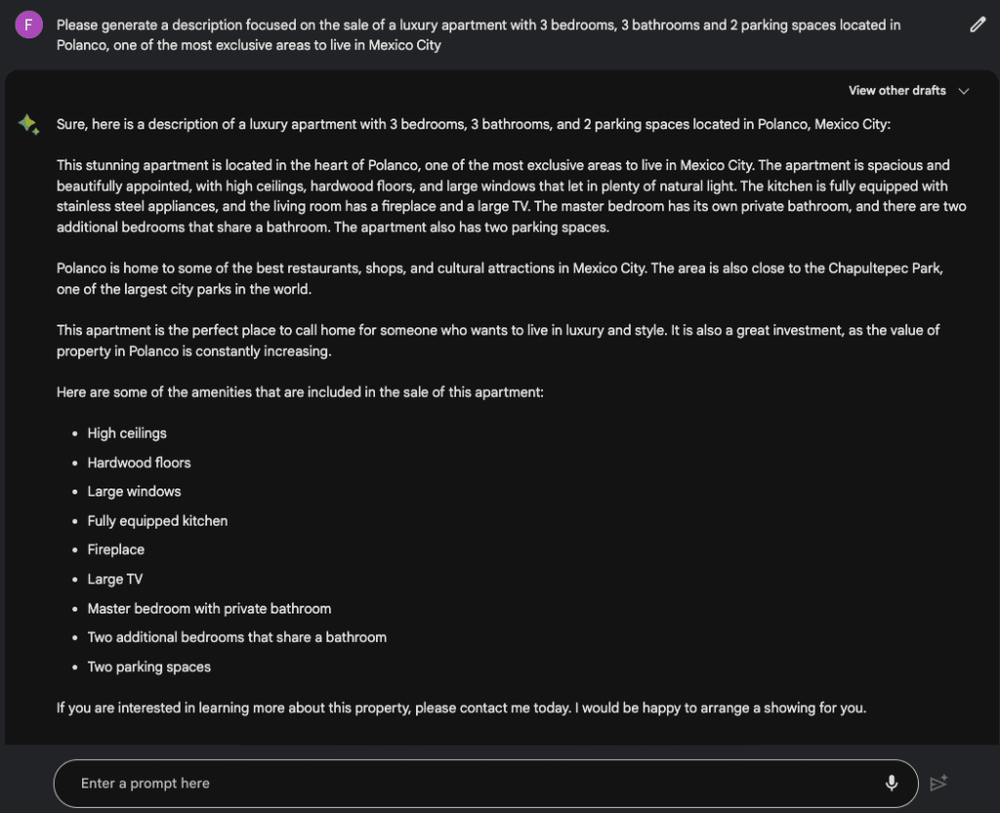
While you already know some key actionables that the tool can currently execute, there are more possibilities to improve other aspects that are not only related to content generation. Let's take a look at them below.
Receive the latest news and updates directly in your inbox.

Alfredo Obregón is the co-founder and CEO of Nolab, a real estate platform focused on investment, sales, and property management across international markets.
jul 7, 2026
5 min.
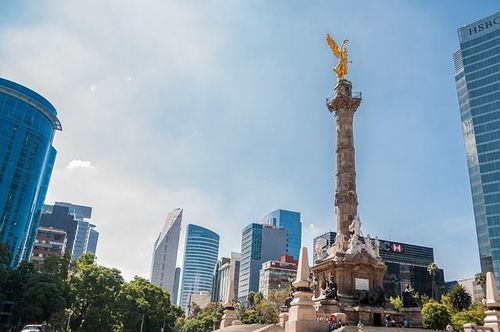
For years, to talk about investing in CDMX was to talk about opportunities. Today, more and more, it means talking about strategy and decisions with real and tangible results in a market that is constantly evolving. The city's real estate market did not stop, but it did change pace: it stopped rewarding intuition and began to demand a reading of context, understanding of the product and clarity about the moment of the cycle. Right now, in 2026, it is no longer just a matter of "investing" or "entering" CDMX, but of knowing where, how and under what logic to do so. Because the city is not growing uniformly: some areas are consolidating as stable and liquid investments, while others are beginning to reconfigure and deserve strategic attention, not impulsive bets. CDMX heading into the future: what is really driving the market? Real estate investment in Mexico City is not experiencing an isolated boom; rather, buyers are now facing an urban reorganization. Demand is increasingly concentrated in well-connected areas, with services, access to employment and real rental capacity. At the same time, the city is pushing towards verticalization, densification and the development of projects that are more efficient in size, operation and maintenance. Added to this are external factors that put pressure on demand: labor mobility, the arrival of foreign capital, international events, which results in a more informed consumer who compares, questions and prioritizes liquidity, so the market is transformed, becoming less emotional and more selective. How to read capital gains in 2026 so as not to confuse luck with strategy. Talking about capital gains without context is one of the most common mistakes when evaluating an investment. In 2026, the capital gain in CDMX is not only explained by "fashion", but by infrastructure, services, perception of safety, connectivity and urban narrative. And above all, by verifiable data that separates speculation from real growth. The analysis of the real estate market between 2023 and 2025 reveals a clear phenomenon: Mexico City is experiencing a reorganization of its demand, where consolidated premium areas maintain stability and high prices, while emerging neighborhoods capture the flow of capital displaced by the rising prices of traditional centers.
jan 7, 2026
12 min.

Discover Gta. Ruiz Giménez 5, the new fractional apartment in Madrid. Fractional ownership with 45 days of use and fractions from 335.000 €.
nov 26, 2025
6 min.